


 English
 日本語
日本語 한국어
한국어 русский
 Español
Safety Round Tip Pet Scissors: Steel, Geometry, and Wholesale Buying Guide
Home / News / Industry News / Safety Round Tip Pet Scissors: Steel, Geometry, and Wholesale Buying Guide
Oct 08, 2026
Content
A groomer trimming the inside corner of a doodle's eye has roughly a centimeter of clearance between the blade point and the cornea. When the dog flinches, that clearance disappears. Safety round tip pet scissors exist to remove that risk without turning the shear into a blunt instrument.
The short version first: a round tip does not make a scissor dull. The cutting edge still runs the full length of the blade; only the final few millimeters at the point are ground into a radius instead of a spike. The shear still opens coat cleanly, but it cannot puncture skin. That single geometric change is why round tip models are the default choice around eyes, ears, paw pads, and sanitary areas.
Three measurements separate a safe tip from a standard point. Specify all three, and repeat orders stay consistent.
What a round tip does not do is slice under a tight mat. Pointed tips can be worked beneath a felted coat; a round tip has to enter from the side. Groomers who handle heavily matted rescues usually keep both profiles on the table for exactly that reason.
The terms get used interchangeably in catalogs, which causes returns. Confirm which profile is on the drawing before you approve a sample.
| Tip profile | Shape | Works best for | Main limitation |
|---|---|---|---|
| Sharp point | Ground to a fine point | Precision work on clean, dry coat | Can puncture skin if the dog moves suddenly |
| Semi-rounded | Small radius, roughly 0.5 to 0.8 mm | Body work on calm, experienced dogs | Still capable of catching thin skin |
| Rounded tip | Ground radius, no separate part | Face, ears, paws, sanitary areas, puppies | Harder to work under matted coat |
| Ball tip | Metal or plastic bead on the point | Entry-level safety and training settings | Bead snags fine coat and is a wear point |
The ball tip is often marketed as the safest option, but the bead sits on the point and can catch in silky coat or on a knot, pulling rather than cutting. For daily professional use, a correctly ground rounded tip on decent steel usually outperforms a beaded design.
Tip geometry is the safety feature; steel is the durability feature. They are specified separately. A 440C shear with a correct radius is safer than a premium VG10 shear ground to a point.
The chart is a directional comparison based on how each steel family is normally heat treated for grooming shears, not a laboratory result for one specific model.
440C stainless steel is the workhorse. Heat treated to roughly 56 to 58 HRC, it takes a durable convex edge, resists staining well enough for a grooming environment, and tolerates being dropped on a tile floor. It is the sensible default for salons buying in volume and for grooming schools where tools take hard use.
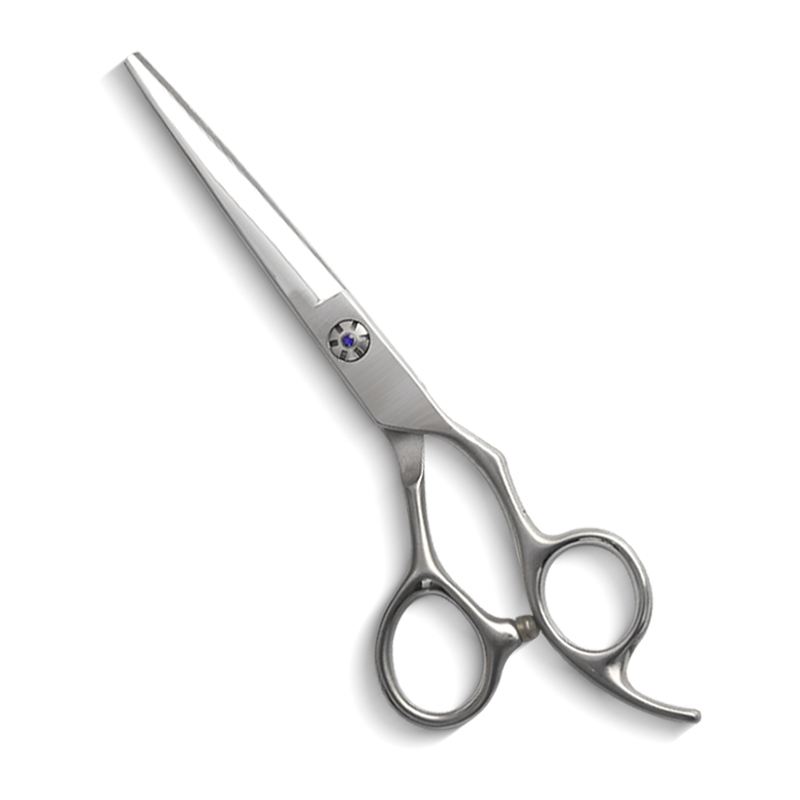 440C Stainless Steel Pet Grooming Scissors for Professional SalonsA durable 440C option for high-volume salons and grooming schools, offering straight, curved, and thinning shapes with stain resistance and edge retention.View Product →
VG10 sits at the top of the range, usually 60 to 61 HRC with a very fine grain structure. It holds a keen edge longer and cuts with less push, which matters at eight dogs a day. It is also less forgiving: a hard edge chips more readily against a knot or a hard floor.
High nitrogen steel is the useful middle ground. Nitrogen improves corrosion resistance compared with plain high-carbon grades, and hardness lands around 59 to 61 HRC, so it holds an edge far longer than 440C while staying more forgiving than maximum-hardness VG10.
Hardness figures get quoted constantly, and 62 HRC is presented as automatically better than 58. It is not that simple. Every point of hardness buys edge retention and costs toughness. A 61 HRC blade cuts beautifully for months, but drop it on ceramic tile and the edge can chip along the rake. A 57 HRC blade is more likely to roll slightly instead, which a sharpener usually corrects in one pass. For a shop with shared tools, the tougher blade often delivers the lower cost per grooming hour.
Edge angle matters just as much. Grooming shears are normally sharpened with a convex edge for smooth cutting, or a flat bevel for a keener but more fragile edge. Coat condition decides which one survives. Dogs that come in off the beach or out of a rural yard carry grit in the coat, and grit chips fine edges quickly, so a convex edge at a slightly wider angle outlasts a thinner design.
High nitrogen steel lands close to the balance point here. The nitrogen-rich microstructure supports 59 to 61 HRC while keeping the grain fine enough to resist chipping better than a carbon-only steel at the same hardness.
High Nitrogen Steel Pet Scissors for Dog and Cat GroomingHigh-nitrogen stainless shears balance 59–61 HRC hardness with chipping resistance, available in straight, curved, and thinning models for frequent grooming.View Product →Length is a control issue rather than a preference. A longer blade covers more coat per stroke but gives less leverage at the tip, which is exactly where accuracy matters near the face.
If you are still mapping coat types to tool types, the coat-density side of the decision is covered in our notes on what to consider when choosing pet grooming scissors.
Round tip shears are used for the most stop-and-start part of a groom, so handle geometry matters more here than on a bulk shear. Three details separate a tool that lasts a full shift from one that does not.
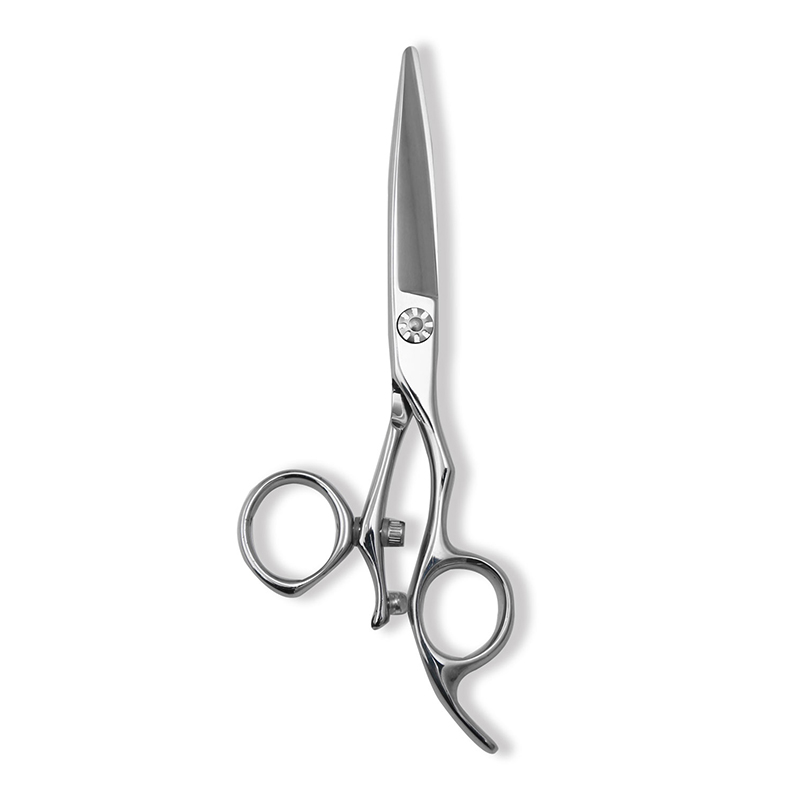
A true offset handle keeps the wrist neutral with the thumb pointing up rather than rotated inward. For face work, where the hand holds a semi-pinch position for minutes at a time, that shows up as noticeably less thumb fatigue by early afternoon.
A ball-bearing tension screw with a lock ring lets the groomer set blade action from feather-light to firm. Too loose and the blades push coat instead of cutting; too tight and every stroke costs the thumb more effort. Tension should be rechecked at each sharpening, because the mating surfaces change slightly once the blades are re-ground.
The correct rest position changes with blade length. A detachable finger rest lets a 4.0-inch face shear run bare while a 7.0-inch body shear keeps one fitted. That is a usability feature, not an accessory.
Before you place a container order, run the sample box through the checks a factory quality team should already be running.
Consistent hardness across repeat orders is what keeps customer reviews stable, which is where an outside laboratory earns its place. Production here is checked on a regular schedule and audited through random sampling by the National Light Industry Tools and Hardware Product Quality Supervision and Testing Center, a stronger guarantee than a certificate covering one earlier batch.
Pet scissors are usually bought as a mixed program: face shears, curved shears, thinners, and chunkers on one purchase order, often across more than one steel family. That mix is workable, but the specification has to be written down, because "round tip" on its own does not survive the trip from a buyer's brief to a workshop drawing.
Put the tip radius in millimeters, the blunt length, the hardness range, the edge type, and the handle offset on the drawing itself. For private label programs, keep steel and hardness identical across colors and finishes; a titanium coating over a 440C body should not change the geometry underneath it.
VG10 pet scissors carry the premium retail position best, provided the shop that resells them understands the edge. A 60 HRC blade should not be used to cut through dirt, and it should never be used to trim dried mud out of a coat. Sold with that guidance, it delivers the cutting feel that justifies the price.
Custom VG10 Steel Pet Scissors for Premium Grooming ProfessionalsJapanese VG10 shears with vanadium, cobalt, and molybdenum deliver premium edge retention; straight, curved, and tooth models suit professional custom grooming orders.View Product →
Plan for sharpening as well. Every pass shortens the blade and re-exposes the tip, so the radius must be re-ground to the original spec. Buyers reselling into markets with few qualified sharpeners should order a slightly larger radius and accept the small loss in point-cutting precision. It is a more honest trade than a safety feature that quietly disappears after the third service. Our own scissor production has run on that principle since 2003, combining hand forging with CNC grinding on the same line.
A safety round tip is a small piece of geometry doing a large amount of work. It keeps the blade away from the places where a flinch turns a routine trim into a vet visit, and it does so without taking away the cutting performance a groomer needs everywhere else on the dog.
What separates a good pair from a mediocre one is not the tip alone. It is whether the radius is ground consistently on both blades, whether the steel was heat treated to a hardness that suits the shop's real working conditions, and whether the tension and handle geometry fit a hand that will hold the shear for hours. Those are manufacturing decisions, and they are worth specifying in writing before the first sample box ships. You can review the full scissor manufacturing operation to see which steel families and handle configurations are available for your program.
Aug 15,2025
Aug 15,2025
Aug 15,2025
Apr 20,2026
Investing in 440C steel hair scissors provides high-volume salons and independent stylists with the...
After years behind the chair, many stylists notice a dull ache at the base of the thumb or a stiffn...
Selecting the right pet grooming scissors requires careful consideration of several factors to ensur...
What Makes High Nitrogen Steel Hair Scissors Different from Standard Scissors Material Compo...
Copyright © 2025 Zhangjiagang Huaxu Hairdressing Tools Co., Ltd. All Rights Reserved

 contact us